
Info
- Dates: 10.10.24 – 02.02.25
- Curator: Camille Morineau, Lucia Pesapane, Vicente Todolì and Fiammetta Griccioli
- Where: Pirelli Hangar Bicocca
- Price: free
The Hangar Bicocca hosts the first major retrospective dedicated to Jean Tinguely since his passing, celebrating the Swiss artist best known for his iconic moving fountain in the square outside the Centre Pompidou. The exhibition is ambitious, showcasing works from across Tinguely’s career, though not in chronological order. Instead, the sculptures are presented freely throughout the vast industrial space, creating a dynamic dialogue between the artworks and the architecture. This is perhaps the exhibition’s greatest strength: the machine-like sculptures seem to meld with the Hangar’s raw environment, appearing as though they are extensions of the space itself.
Most of Tinguely’s kinetic sculptures are fully operational, as originally intended. The exhibition is conceived as a kind of choreography, where the machines are automatically activated in sequence, creating a persistent symphony of sounds that accompanies the visitor throughout the experience. Visitors are drawn from one machine to the next, following the sounds and then observing their movements. The whir of belts, the clank of metal, wheels, gears… Tinguely’s conceptions have no specific utility; instead, they aim to showcase the intrinsic beauty of machines.

In stark contrast to the success of Pop Art during those years, Tinguely’s works are more closely aligned with French Nouveau Réalisme, where discarded materials and industrial debris are transformed into works of art. At times, the exhibition even allows visitors to activate the sculptures themselves. One such example is Méta-Matic No.10 (1959), a drawing machine that lets visitors interact with the mechanism to create abstract, randomly generated artworks. This piece, like many of Tinguely’s works, embodies a core principle of his art: making art accessible to everyone—not just to view but to create. With a token from the bookshop, visitors can produce a drawing, just as audiences did in 1959 at the Galerie Iris Clert in Paris.
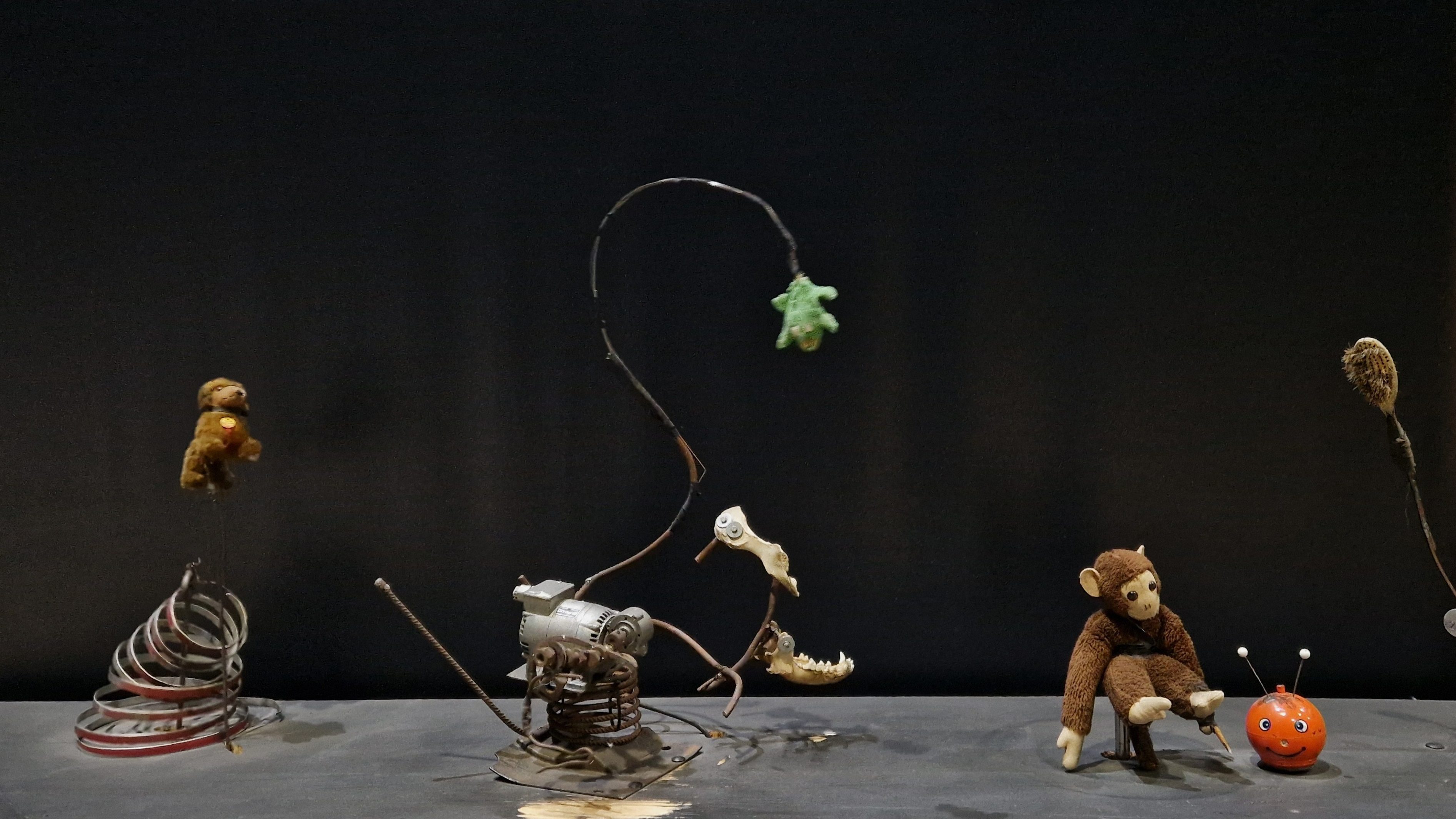

Similarly, Machinebar invites visitors to engage playfully by pressing buttons connected to various elements (toys, tools, and sculptures crafted from discarded materials). Each button activates a different element, producing unique sounds, adding to the exhibition’s lively atmosphere.
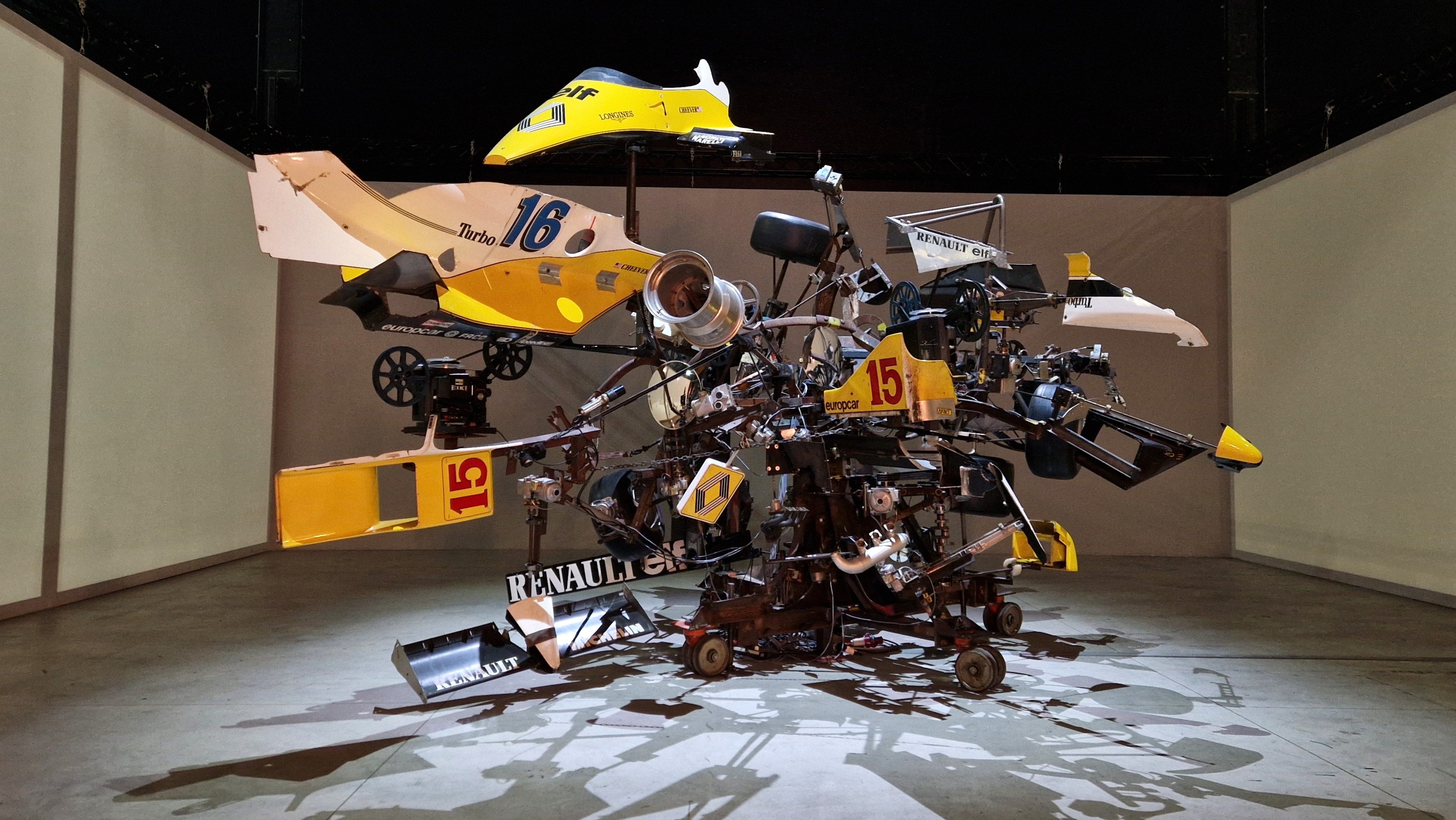
Tinguely’s lifelong fascination with engines and automobiles is also a recurring theme in the show. Works like Schreckenskarrette-Viva Ferrari (1985) and Pit-Stop (1984) reference his love for racing cars. The latter, commissioned by Renault, incorporates parts from actual Formula 1 race cars used in Grand Prix events, embodying Tinguely’s ability to merge artistic ingenuity with industrial remnants.
The exhibition concludes with one of Tinguely’s final collaborations with Niki de Saint Phalle: Le champignon magique (1989). This piece features mechanical arms that rotate around the mushroom’s head; the sparkling sculpture stands in contrast to the darker tones of earlier works and the collaboration between the two is clearly visible. Tinguely and de Saint Phalle where a couple in life but also within their career, many iconic pieces sorted out the two.
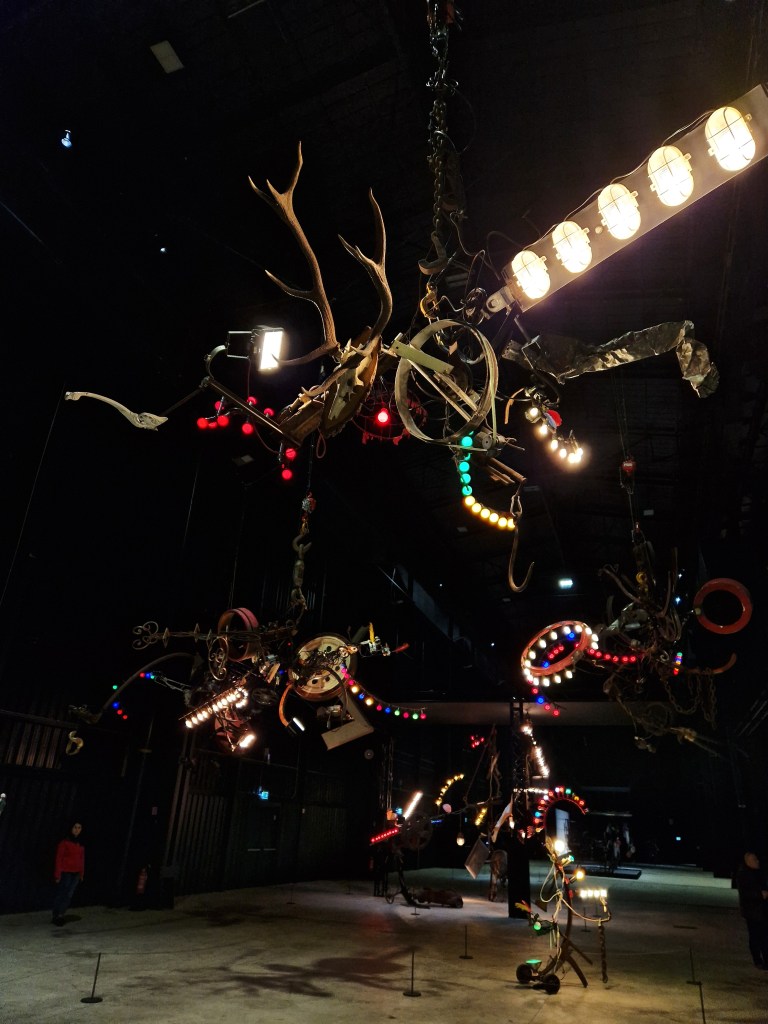

In the darkness of the Hangar, Tinguely’s sculptures gradually emerge, their tones blending into the space. It’s the mechanical sounds that guide visitors through this playful and ironic journey, capturing the artist’s unique ability to transform discarded objects into imaginative, mechanical marvels.
This retrospective highlights how Tinguely’s art, remains deeply relevant today. His critique of the industrial and technological transformations of his time resonates in the present, as his ephemeral and minimalist creations continue to inspire contemporary artists. The exhibition also pays homage to Tinguely’s lasting legacy. A testament to his singular mark on art history is the story of his funeral in 1991, where, on his request, a celebratory parade was led by his machine Klamauk, mounted on a tractor, guiding the procession with its rhythmic beats and bursts of firecrackers—a fitting tribute to an artist who celebrated life through motion and sound.
My personal highlights:
- Méta-Herbin, 1954
- Méta-Matic No.10, 1959
- Requiem pour une feuille morte, 1967
- Pit-Stop, 1984
 MUSEmemoirs