Info
- Dates: 12.10.24 – 16.03.25
- Curator: Marie Perennès
- Where: Fondation Cartier pour l’art contemporain
- Price: 11 euros /7,50 euros reduced
The Fondation Cartier presents the first major retrospective of Colombian artist Olga de Amaral (1932–). With more than 80 works on display—many exhibited for the first time outside Colombia—the exhibition offers a rare and comprehensive exploration of the career of this pioneering figure in the Fiber Art movement. Spanning from the 1960s to today, the retrospective provides an in-depth look at the evolution of an artist who has redefined the boundaries between fine art and textile art.
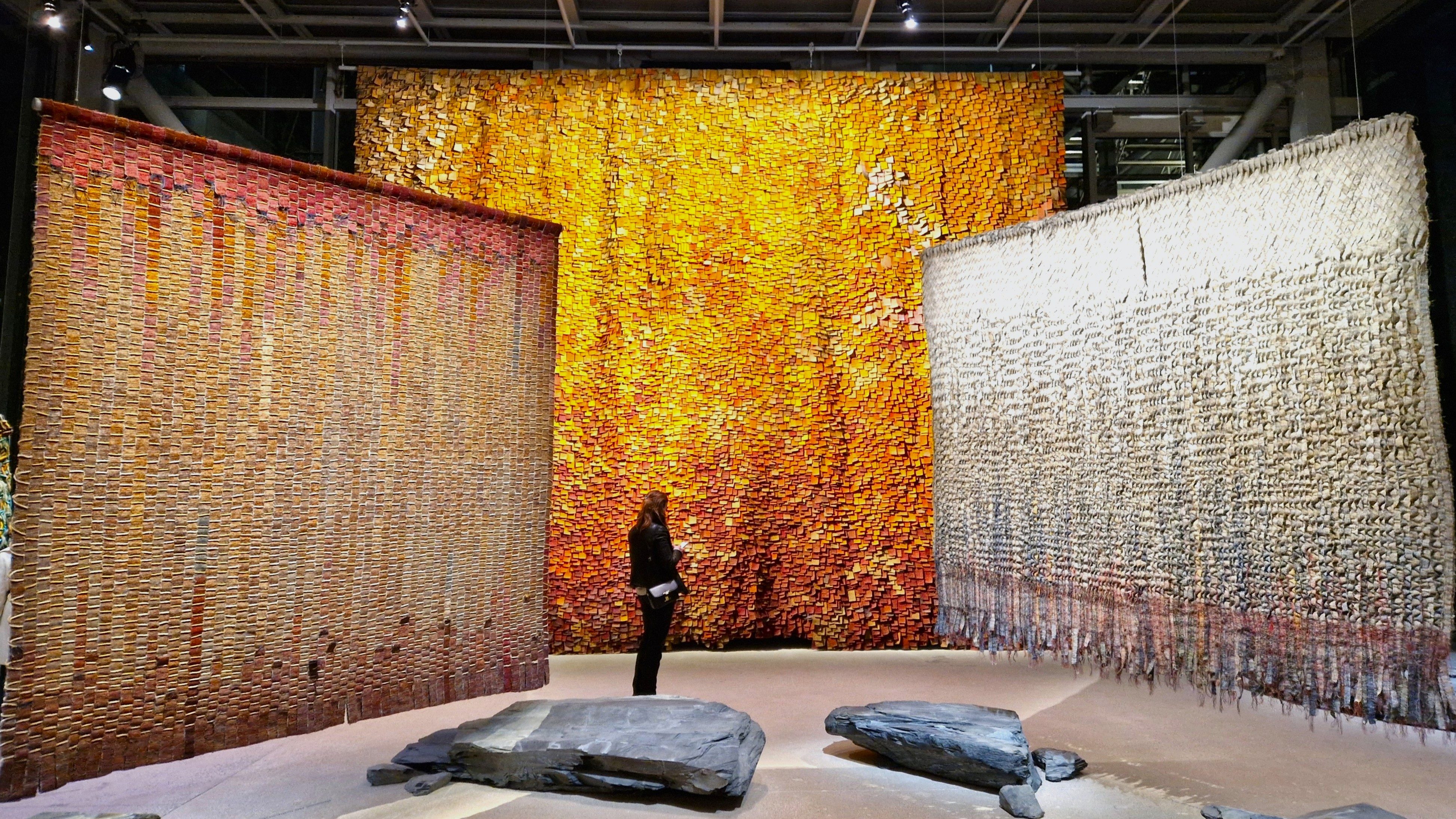
The exhibition’s architecture, specifically designed by Lina Ghotmeh, is deeply inspired by Olga de Amaral’s profound connection to nature. The Fondation Cartier’s iconic glass façade allows the artworks to engage with the surrounding environment, enhancing the dialogue between interior and exterior. The exhibition is divided into two distinct sections: the ground floor showcases Amaral’s monumental works, that captivate and immerse the visitor in her universe, while the basement offers a chronological and thematic presentation of her work. This dual approach invites a deeper understanding of the artist’s practice and the difference shades of her creations.
Olga de Amaral discovered the potential of textile practices during her studies at the Cranbrook Academy of Art in Michigan, where she moved in 1954 in reason of the political turmoil in her country. The Cranbrook school at the time was the heir of the German Bauhaus’ ideals, the place where many professors moved to after quitting Germany because of the Nazi regime. At Cranbrook, in line with the most important principle of the Bauhaus, there was no distiction between applied arts and fine arts. It is within this open environment that she learnt about textile and its techniques; she also conducted researches to experiment with colour and materials. After one year at the school, she went back to Bogota, to fully dedicate her life to art.
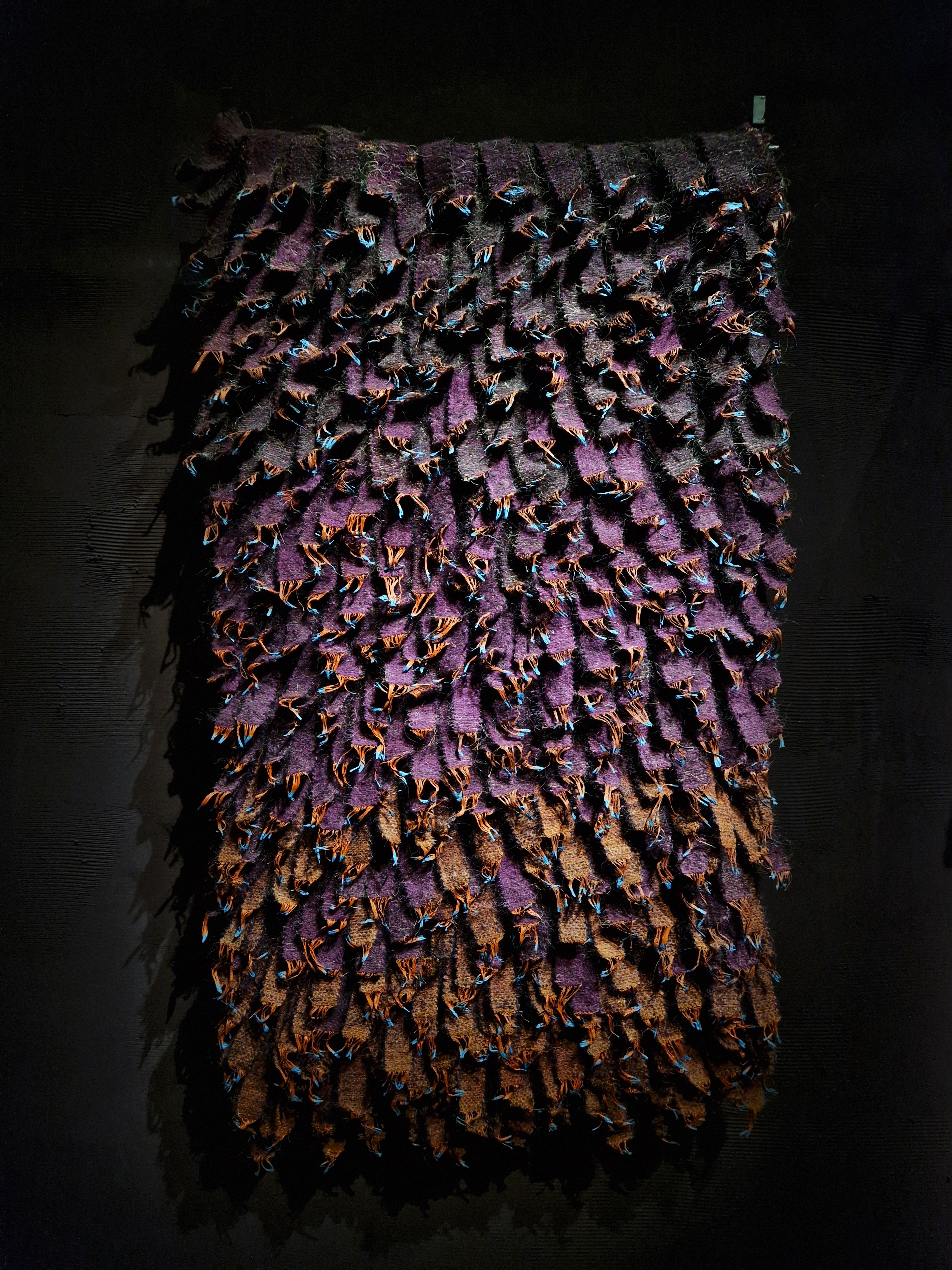
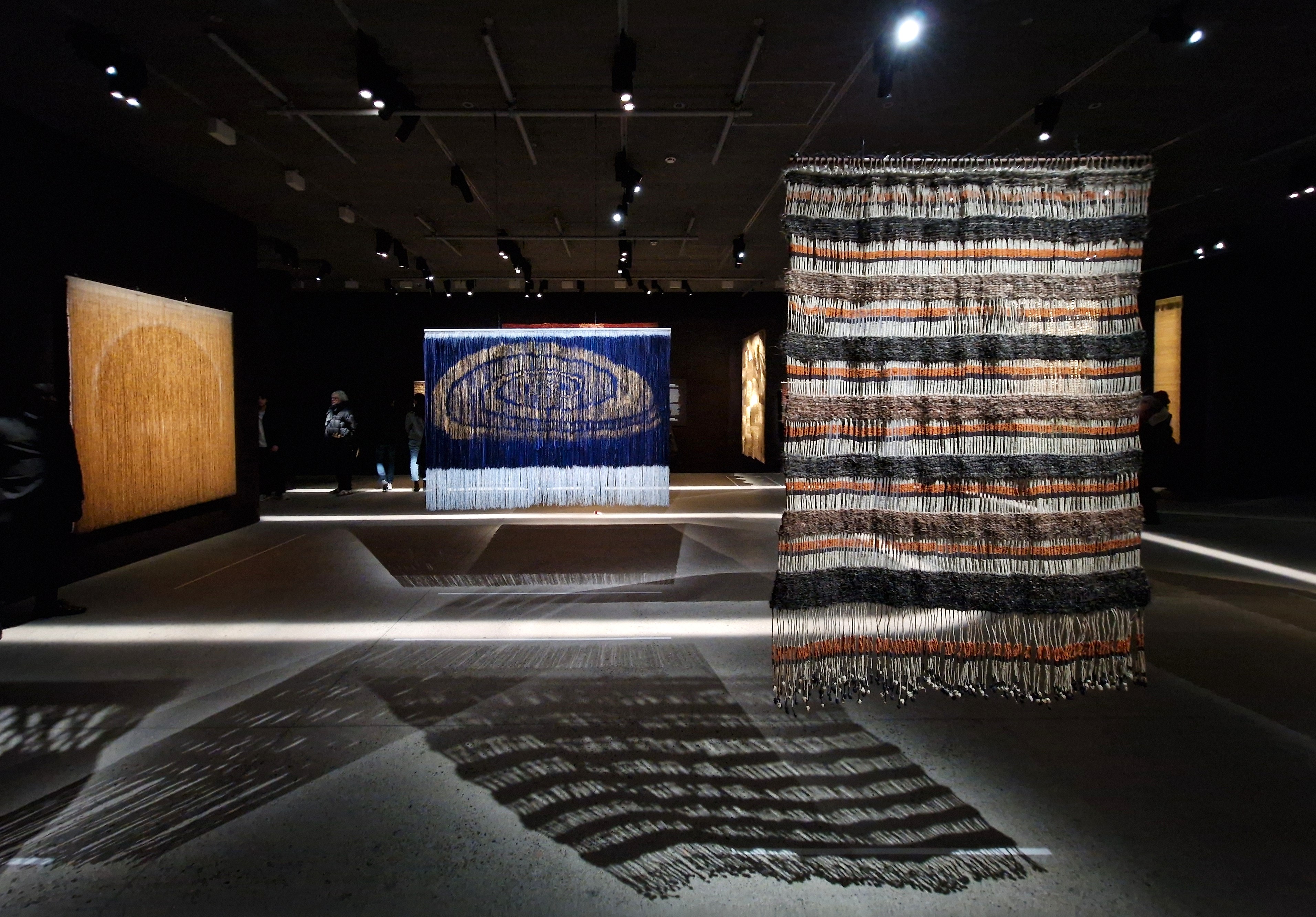
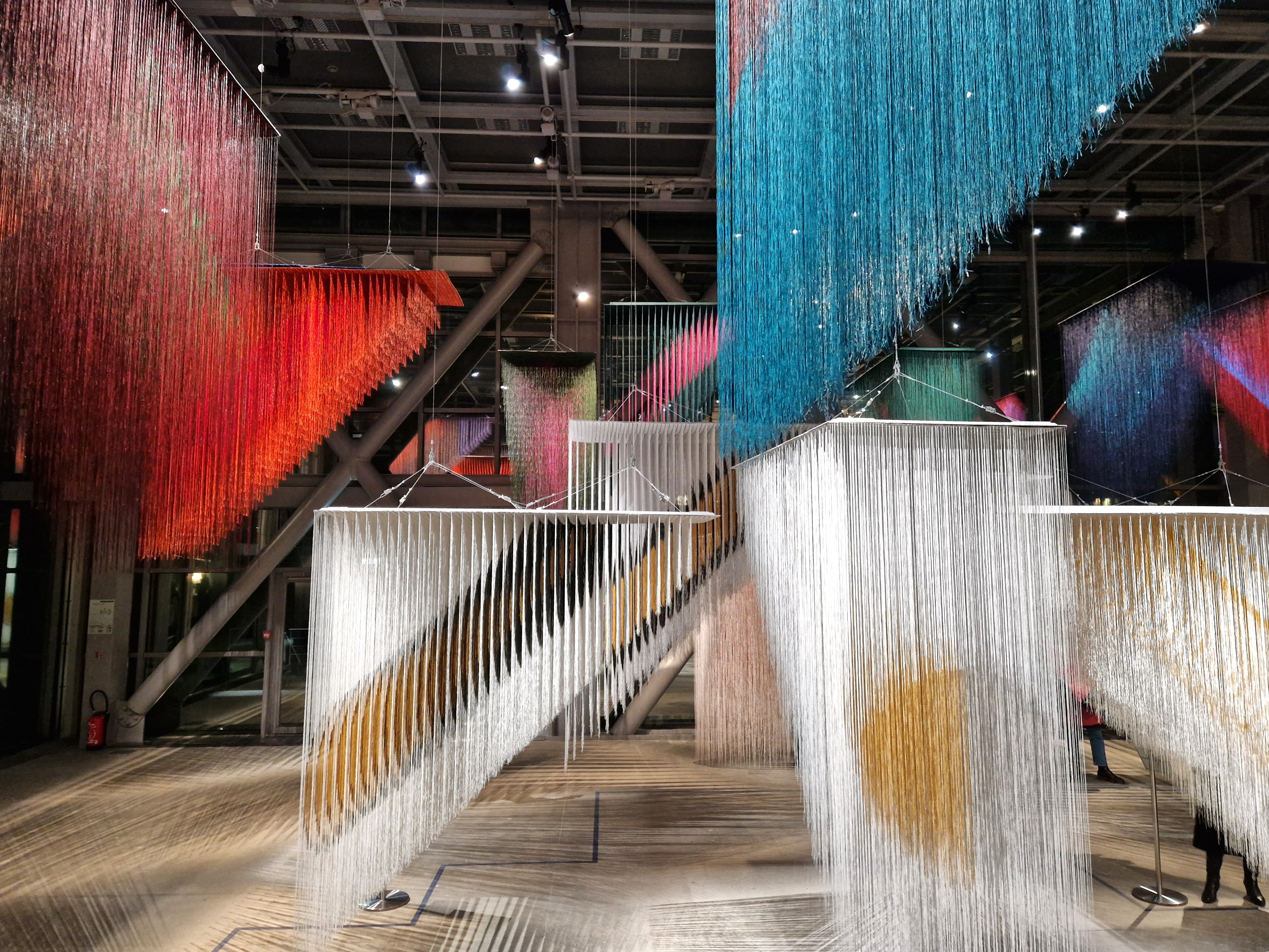
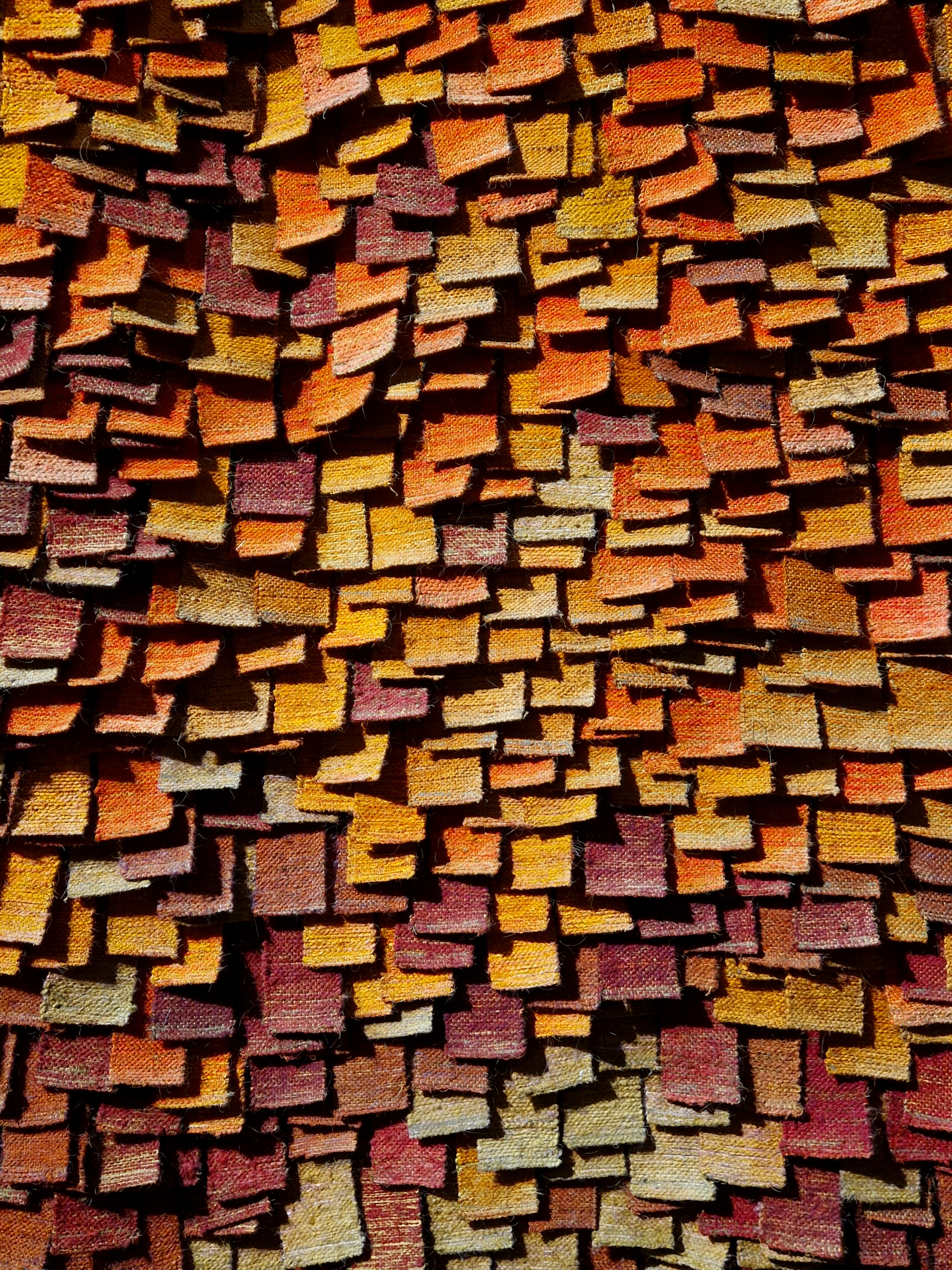
Walking through the exhibition, visitors are struck by the richness of her color palette and the intricate textures of her weavings. Each piece demands a closer look, inviting viewers to examine the interplay of threads, layers, and light. De Amaral demonstrated how to elevate a practice traditionally relegated to the domestic sphere, asserting its place within the canon of fine art. The exhibition display amplifies this experience, with many works suspended in mid-air. This allows viewers to turn around them, uncovering their intricate details from multiple perspectives. The contrast between the vibrant colors of the works and the surrounding darkness creates a magical atmosphere.
I live colour. I know it is a subconscious language and I understand it. Colour is like a friend, it accompanies me.
– Olga de Amaral
The artist’s relationship with color is a central theme of the exhibition, as seen in the vivid tones that characterize her works. Gold also plays a pivotal role in her artistic language. In the 1980s, the artist began incorporating gold leaf into her pieces, seeking to capture light and connotate her works with a spiritual resonance. For her, gold is not merely a material but a metaphor for luminosity, divinity, and the transcendent. This is especially evident in her Estelas series, begun in 1996. These monumental structures, made of cotton threads and layered with gesso, paint, and gold leaf, evoke the ancient funerary stelae of pre-Columbian archaeological sites.
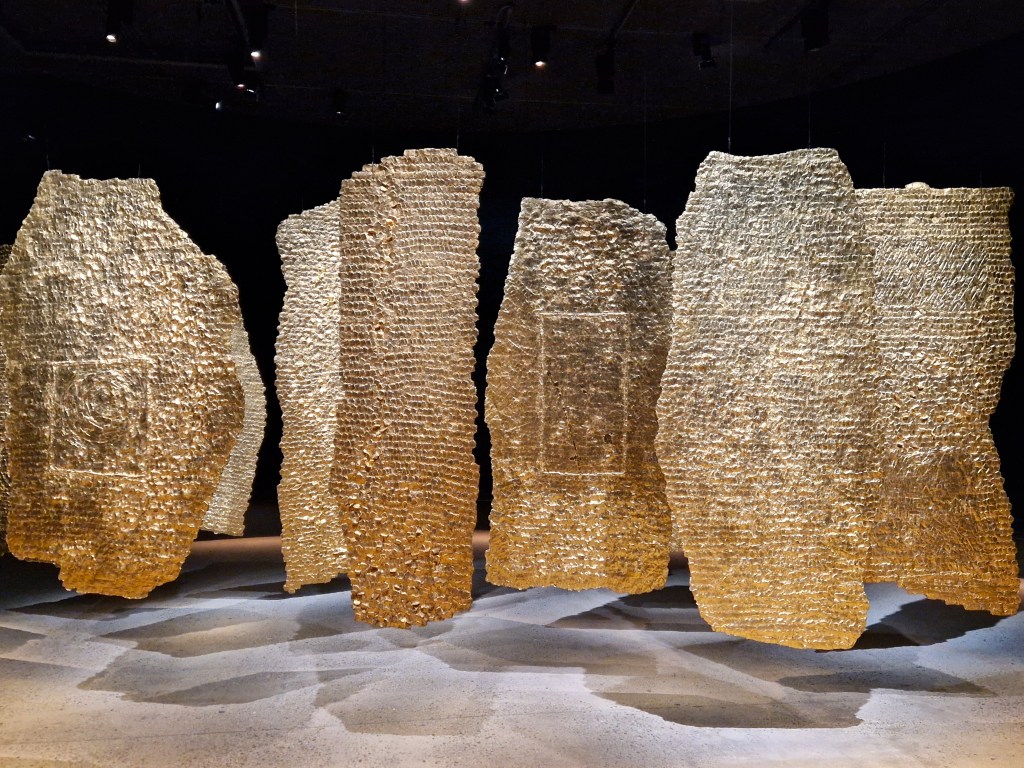
Displayed in a separated dark space, the Estelas‘ room invite meditation and introspection, with a bench encouraging the visitor to a moment of pause, reflection and silence.
De Amaral’s work draws on the rich ancestral traditions of her Colombian heritage. Her textiles echo the quipus of the Incas, where knotted cords were used to transmit tales across generations. Her ability to merge the modernist techniques learned at Cranbrook with the landscapes, cultural heritage, and vibrant traditions of Colombia results in works that seem to emanate light and energy.
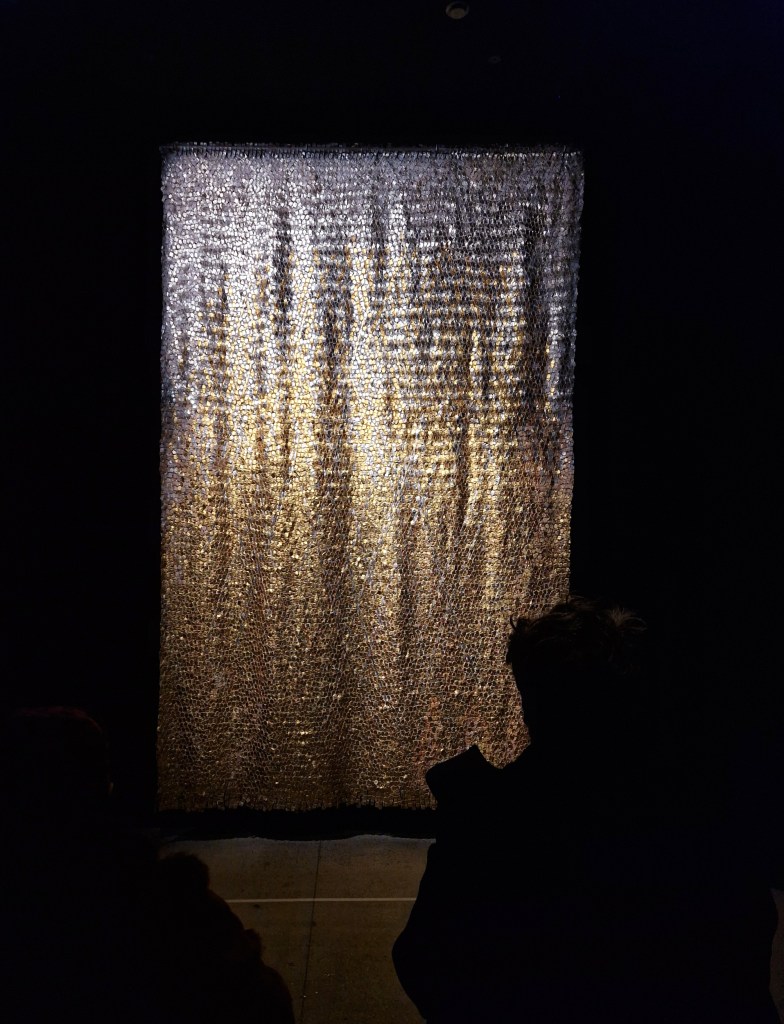
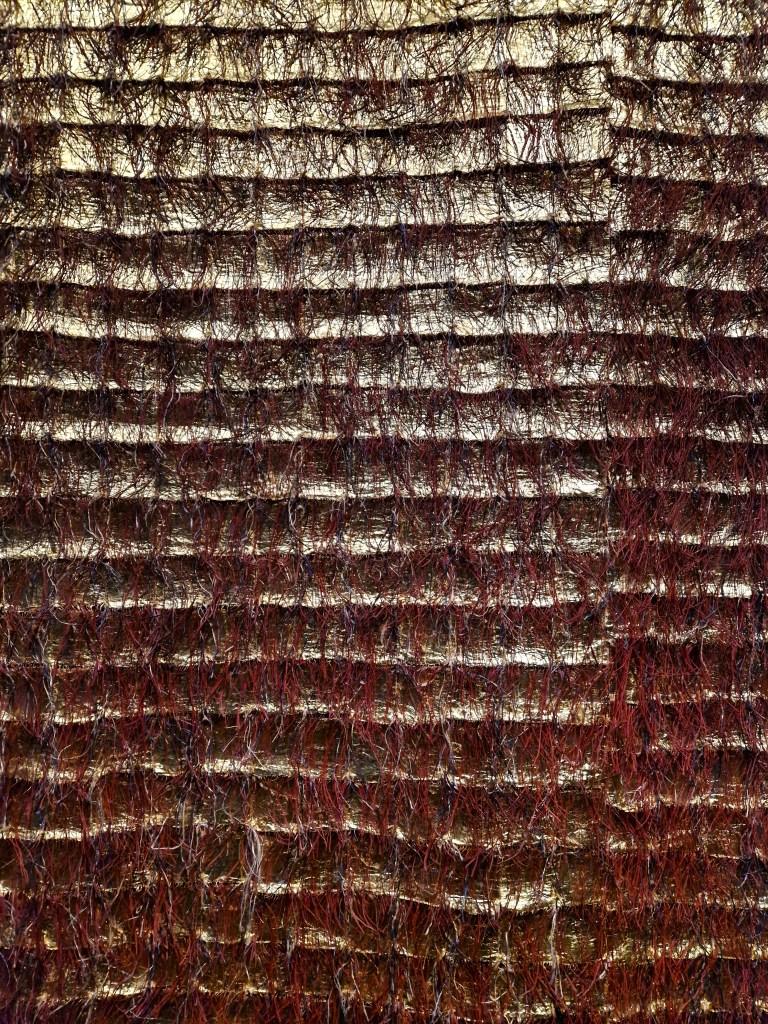
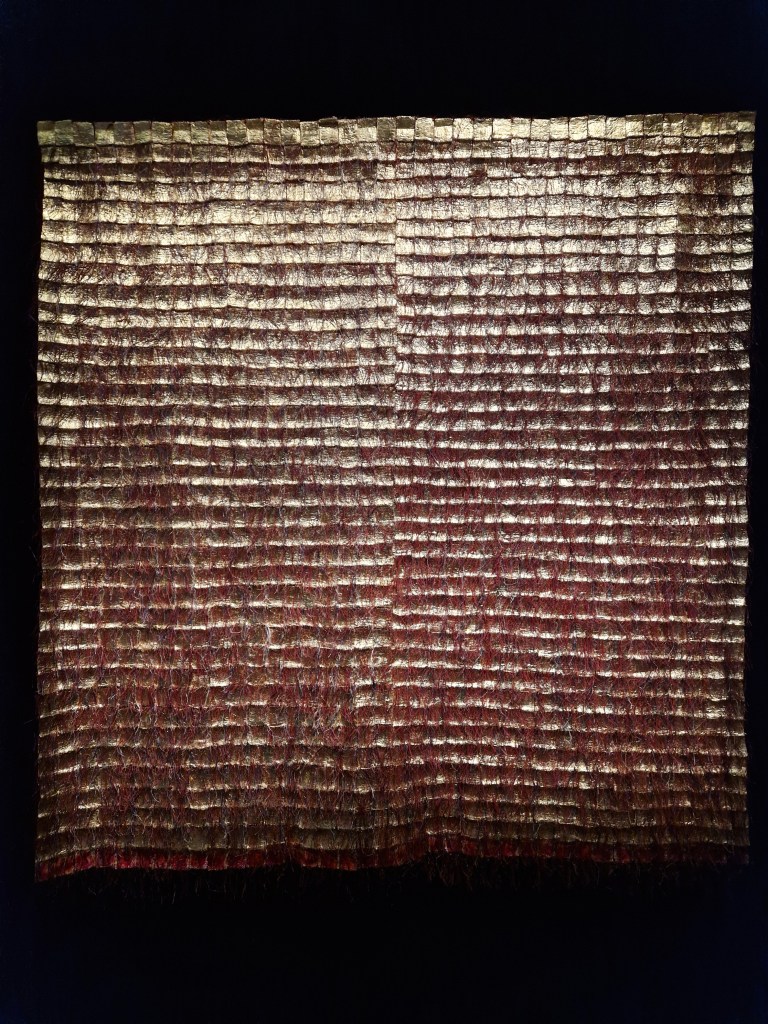
Natural elements—stones, geological layers, and the textures of the Earth—are recurring sources of inspiration in her practice. The stratified surfaces of her works mirror the layered composition of the earth, and especially the landscapes of her beloved Colombia, transforming textiles into topographies that invite both tactile and visual exploration.
Olga de Amaral’s art transcends boundaries, merging craft with fine art, the ancestral with the modern, and the tangible with the spiritual. Through this retrospective, visitors are invited to experience the techinicity as well as the power of her work, a celebration of materials, light, and cultural memory that has redefined the movement of Fiber Art.
My personal highlights:
- Muro en rojos (1982)
- Estelas (1996 – 2018)
- Strata XV (2009)
- Pozo azul 11/13 (2012)
- Alquimia 50 (1987)
 MUSEmemoirs