Info:
- Dates: 09.04.25 – 31.08.25
- Curator: Suzanne Pagé and Sir Norman Rosenthal
- Where: Fondation Louis Vuitton
- Price: 16 euros/ 10 euros reduced
With this major retrospective, David Hockney takes over the entire Fondation Louis Vuitton, presenting more than 400 works and offering a comprehensive overview of the last 25 years of his production, while also revisiting key moments from earlier periods. This expansive selection reflects the dynamism of the British painter’s practice, revealing both the evolution of his techniques and the recurring themes that define his visual language. Through a thoughtful selection of drawings, paintings, photographs and digital experiments, the exhibition traces the evolution of Hockney’s practice, its shifts in medium, location, and sensibility, highlighting both the formal experimentation and the deeply personal themes that anchor his work. The viewer is invited to discover, or rediscover, an artist who never ceases to explore new perspectives and create.
From the outset, the visitor is immersed in Hockney’s vibrant world. After a brief encounter with earlier pieces, one is quickly led into the heart of his most iconic works. The scenography of the exhibition is carefully color-coded: each thematic section or phase of Hockney’s life is distinguished by a different hue, making the chromatic explosion all the more captivating. The result is an almost synesthetic experience, as every room bursts with colour that surrounds and envelops the viewer.
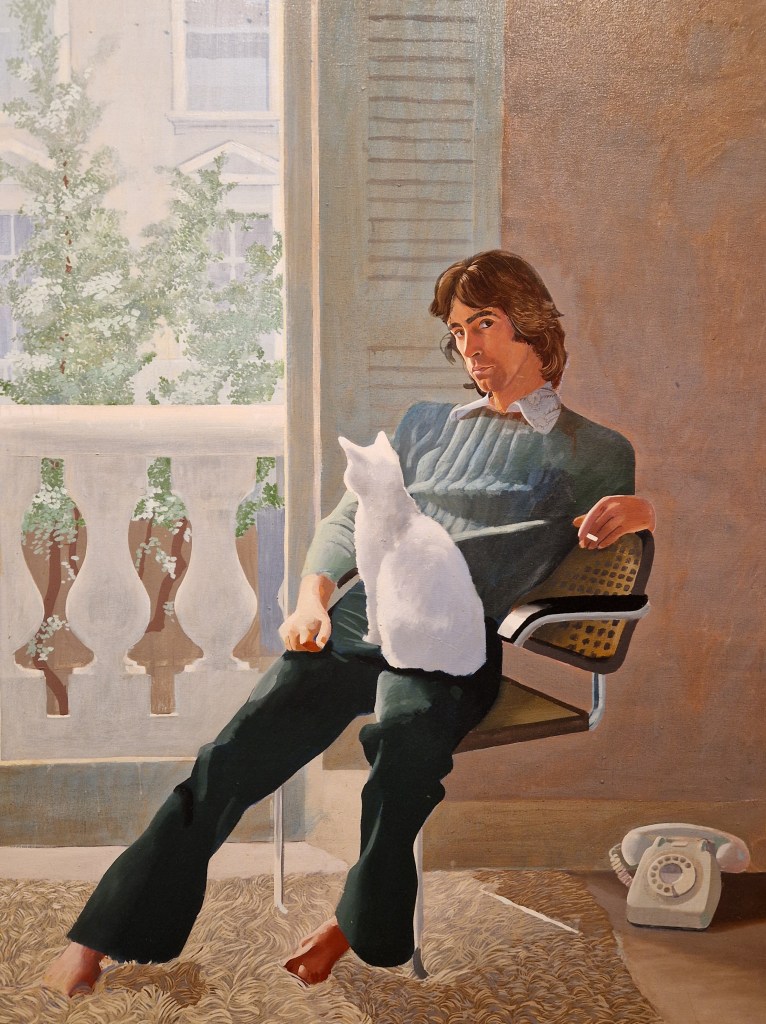
Mr and Mrs Clark and Percy, 1970-71 (detail)
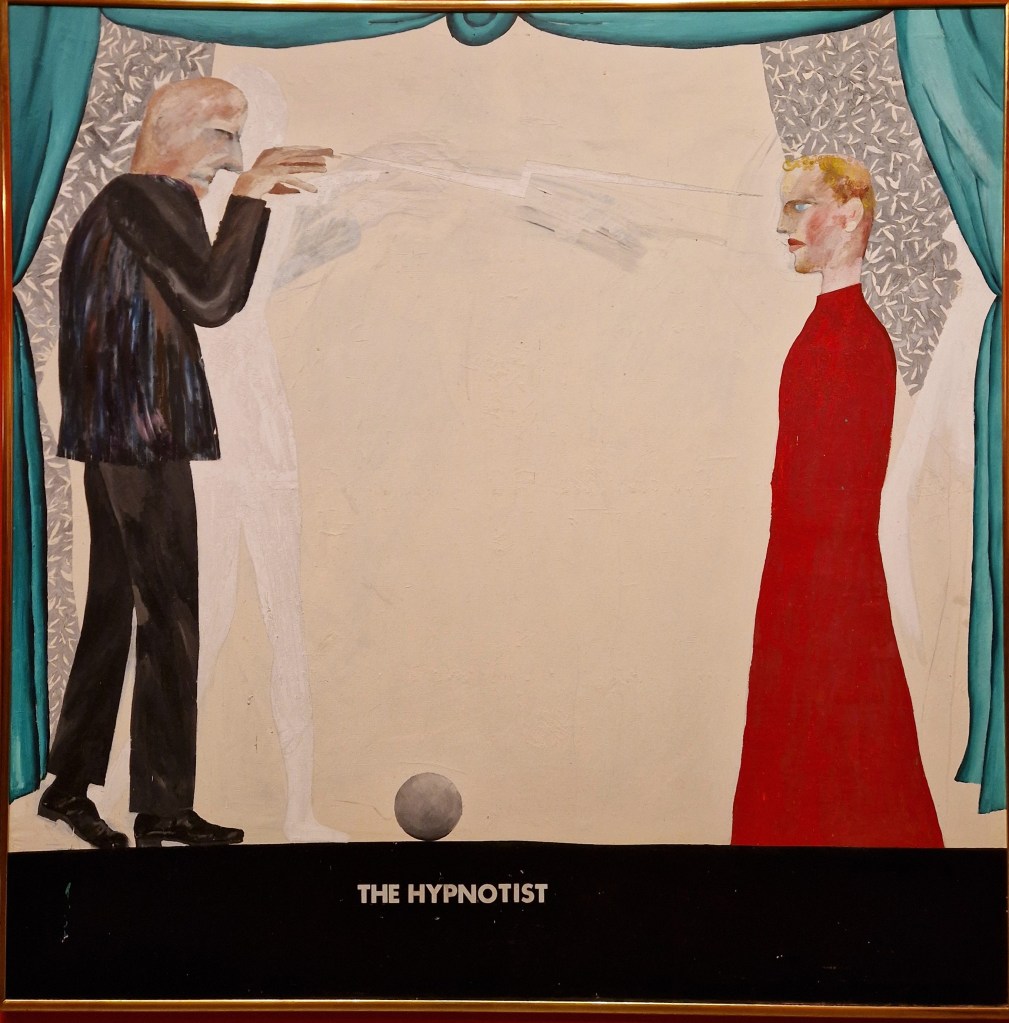
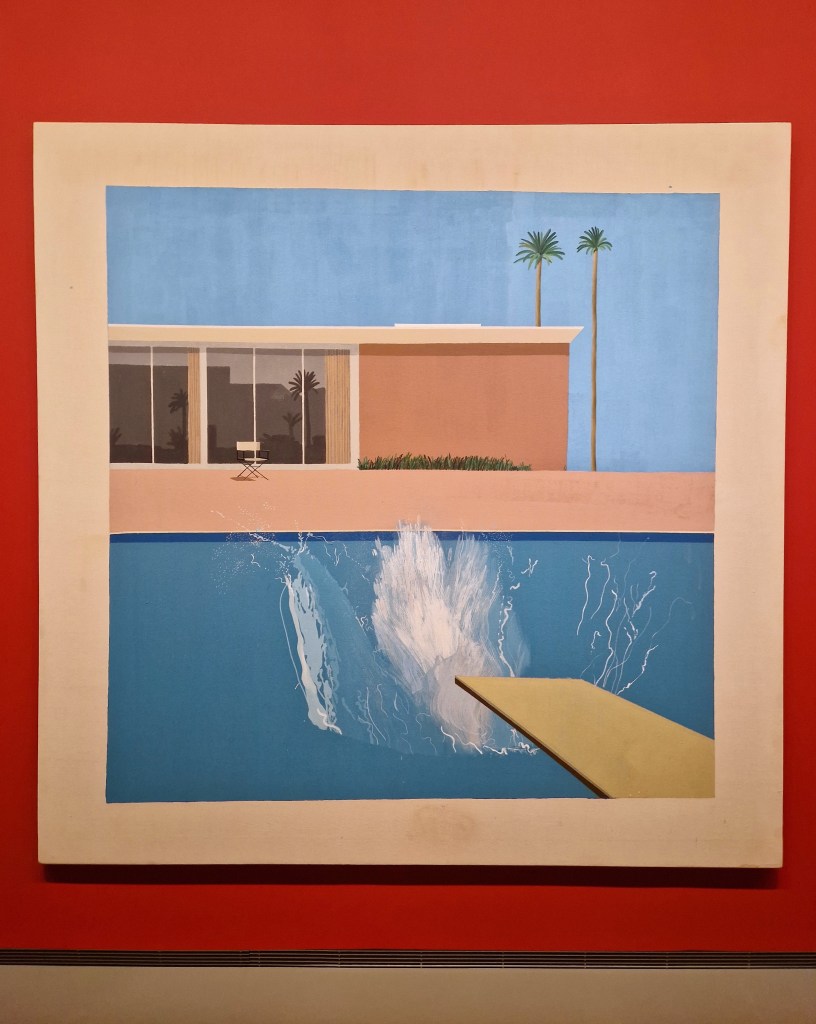
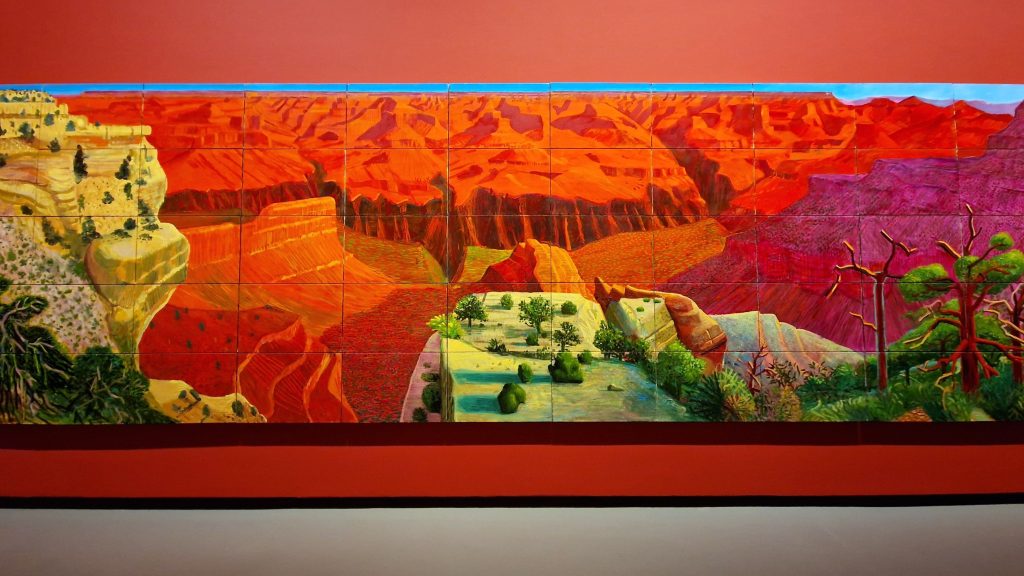
The exhibition opens with Hockney’s early works from his London years. It is striking to see how, from the very beginning, he remained faithful to figuration—even during periods when abstraction dominated the art scene. In 1964, Hockney moved to Los Angeles, a city that would become a central reference throughout his life. This section of the show presents some of his most emblematic works, including the celebrated A Bigger Splash. The paintings from this period reflect the brightness and clarity of the Californian environment, with stylised compositions, simple forms, and luminous colour palettes. Also featured are his panoramic views of the Grand Canyon, inspired by a trip to Arizona. The monumental A Bigger Grand Canyon already hints at Hockney’s fascination with juxtaposition and multiple points of view, a motif that will become increasingly prominent in his later works.
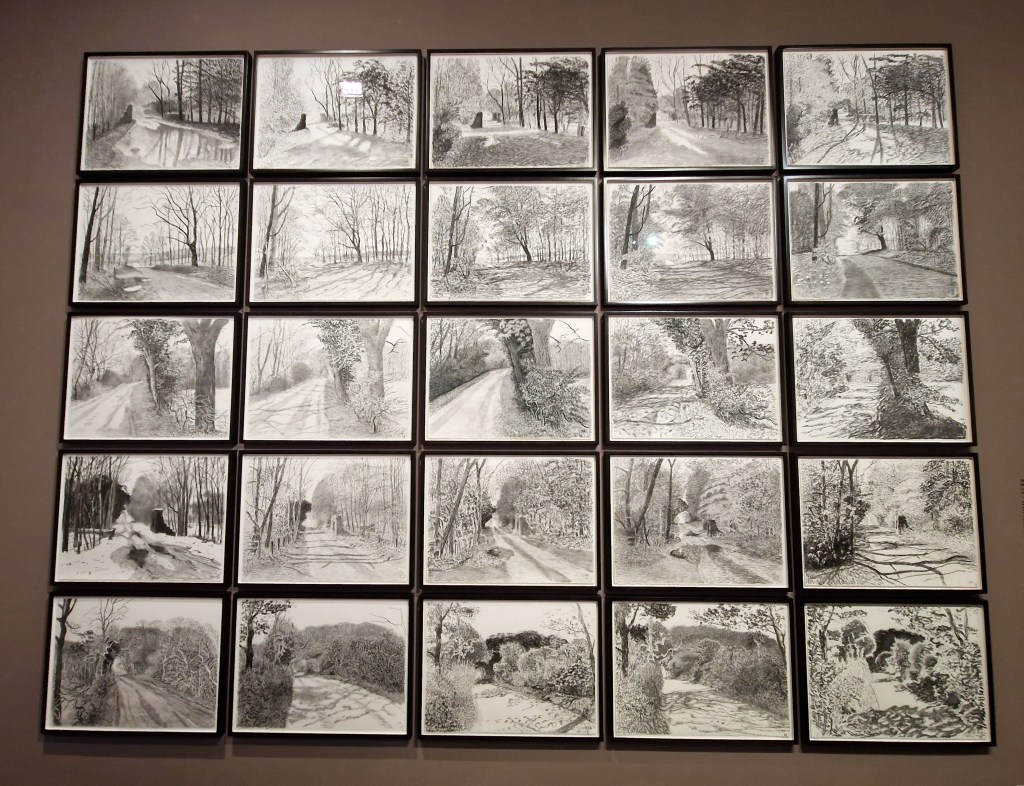
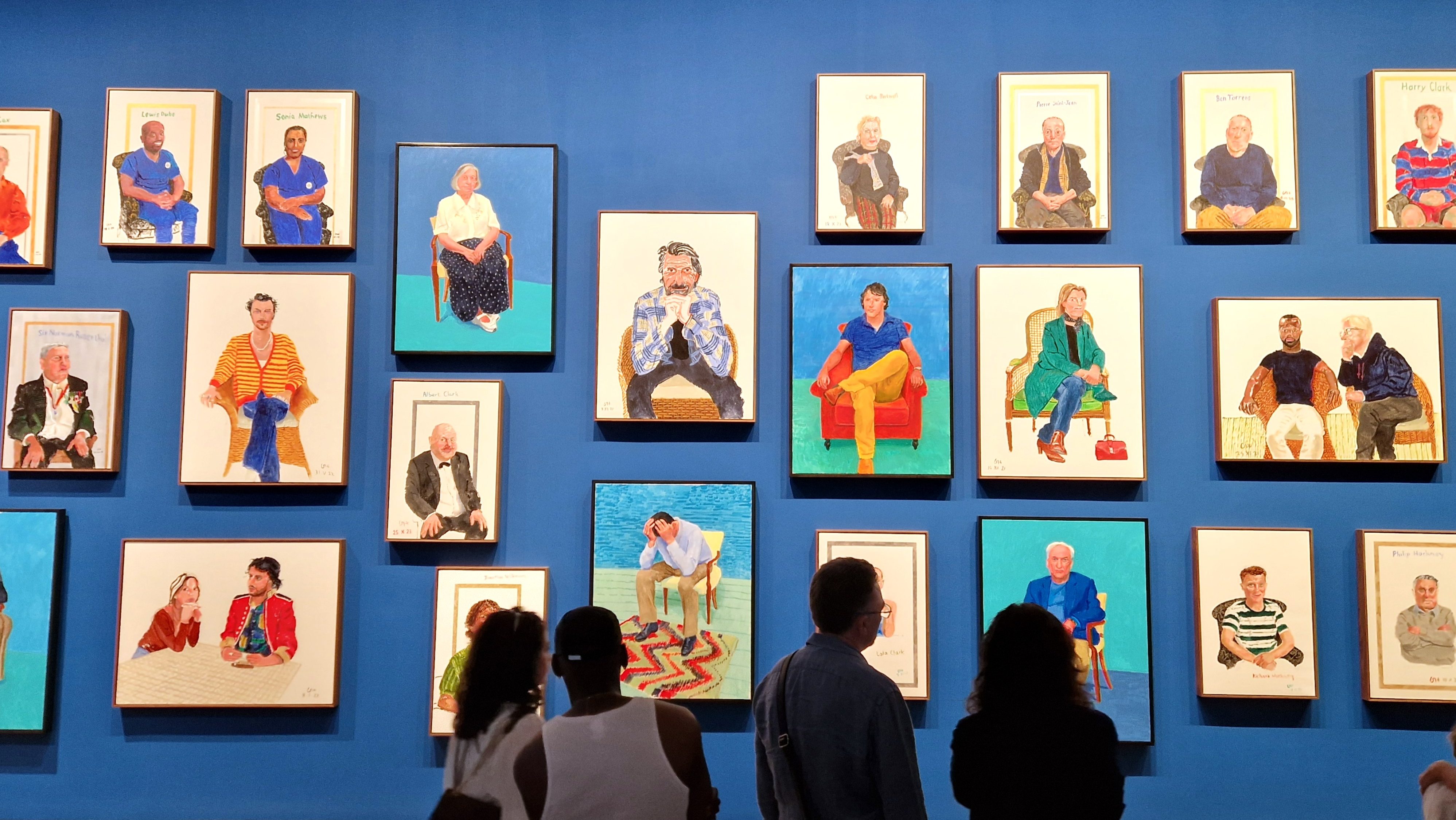
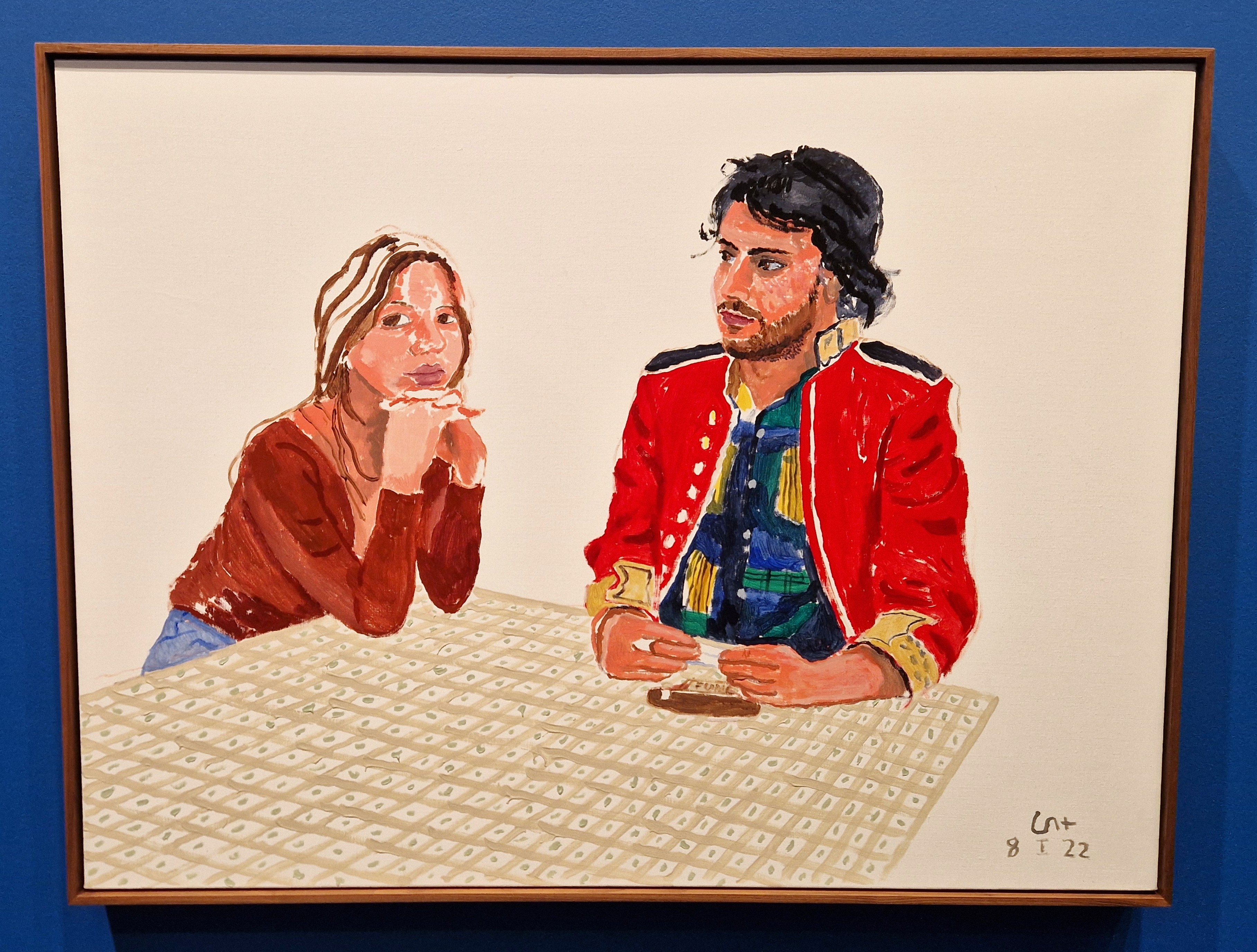
In the late 1990s, following the death of his mother, Hockney returned to Yorkshire, his native region. This period marked a shift in focus toward nature and the changing seasons. Landscape became dominant in his work, with trees and forests recurring throughout. Hockney embraced traditional techniques during this time, methods he would never abandon even as he pursued new media. Portraiture, however, remained a constant. From the beginning of his career, Hockney has portrayed those closest to him: friends, family, and himself. One particularly striking display is the ‘portraits wall’ on the ground floor, a vast collection of paintings from different periods that testifies to the continuity of his relationships and the emotional depth of his gaze.


In 2019, Hockney settled in a small village in Normandy, where he spent the Covid-19 lockdown. 220 for 2020 is a series of digital drawings created on his iPad during this time, which he sent to friends to lift their spirits. A selection of these works is exhibited on the first floor. They represent an exercise in daily observation of the natural world and the passage of time. In the Normandy countryside, Hockney found a renewed inspiration, aided by the immediacy and fluidity of the iPad as a tool for creation.
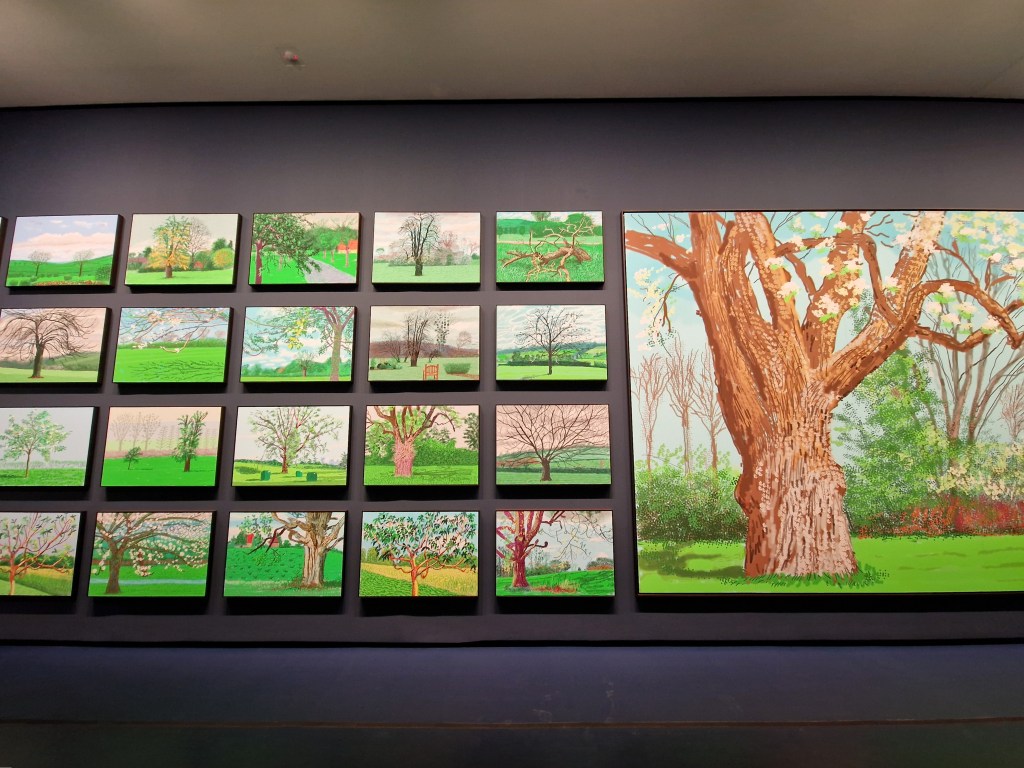
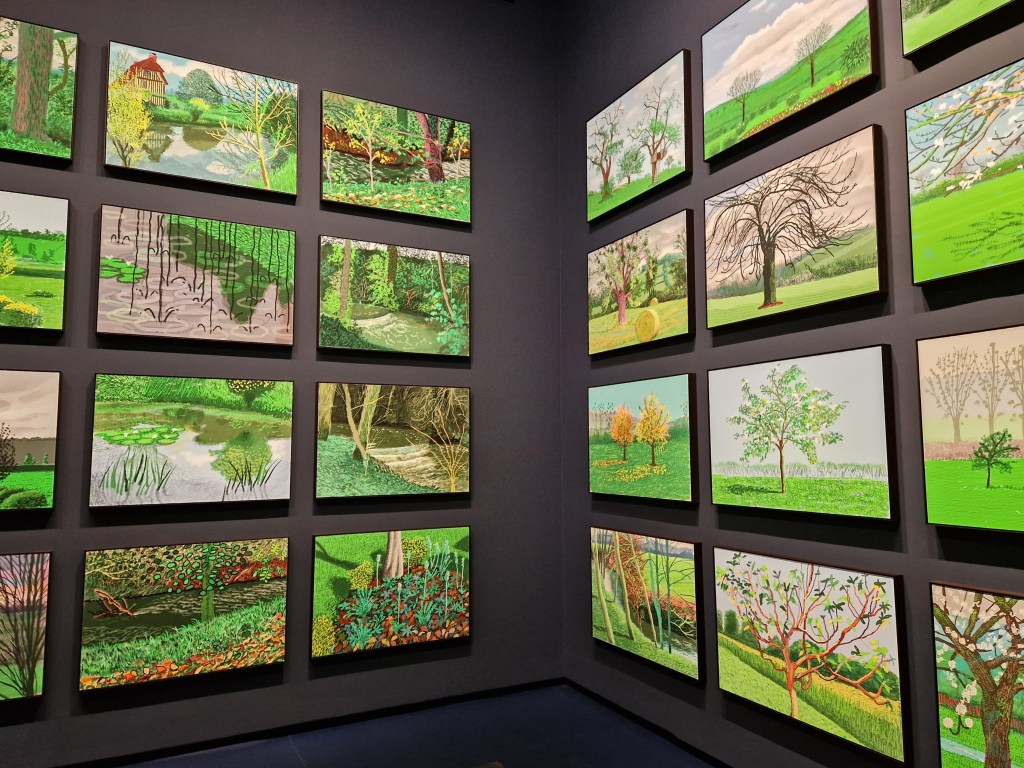
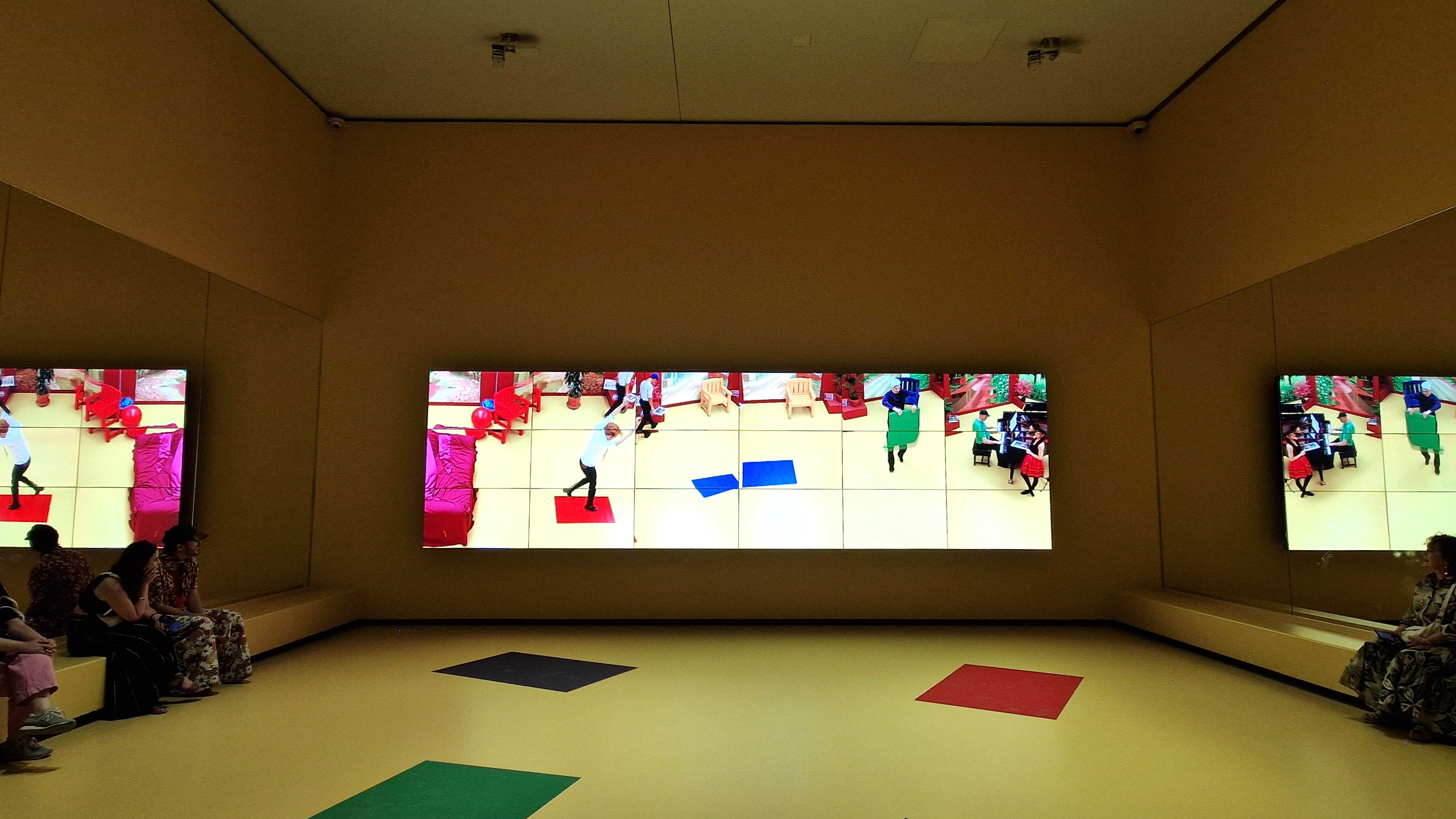
His interest in spatial experimentation—particularly in trompe-l’œil and multiple perspectives—is also explored through his photographic montages. By assembling various views of a single scene into one composition, Hockney produces images that are realistic and immersive, yet without a single focal point. The viewer’s eye is invited to wander across the entire surface, becoming an active participant in the scene. In the 2010s, he extended this process to video, resulting in works like A Bigger Space for Dancing. Using multiple cameras filming simultaneously, Hockney captures the dynamic essence of a ballet class. The effect is intensified by the exhibition design: the video is projected in a mirrored space reminiscent of a dance studio, creating an engaging, all-encompassing experience.
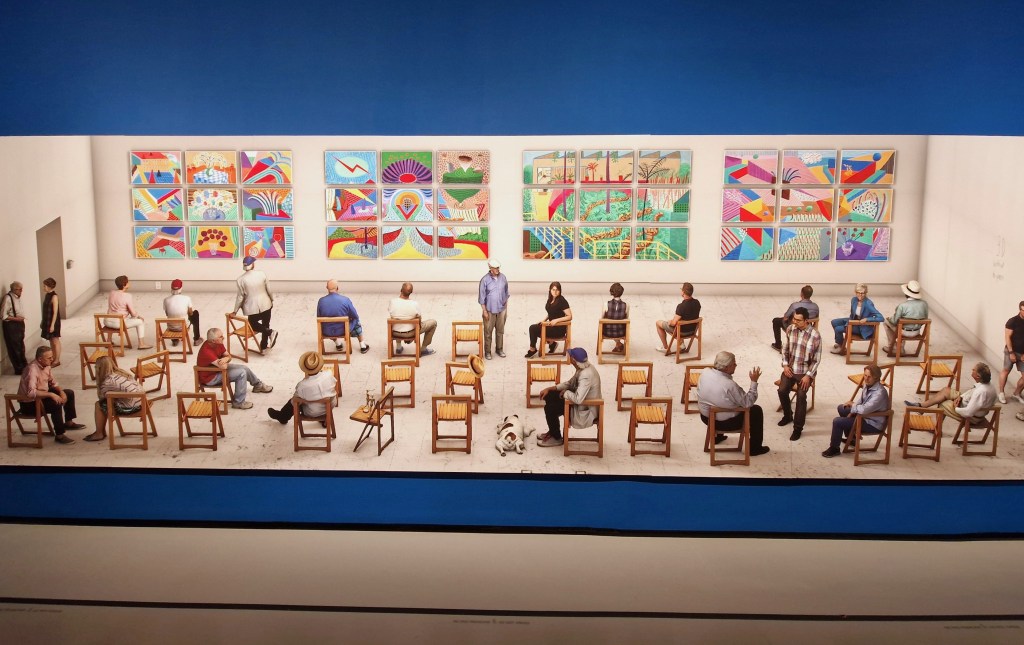
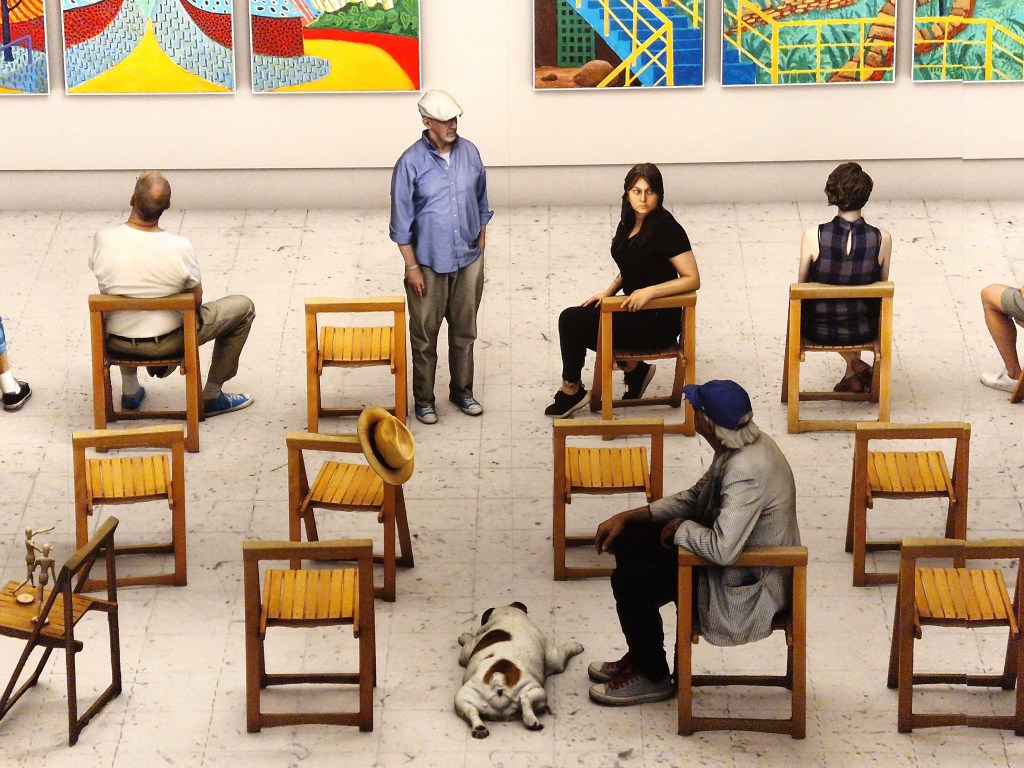
Throughout the exhibition, immersive displays invite viewers to move and explore. One of the most surprising and enchanting sections is the final room, Hockney Paints the Stage. Specifically conceived for this show, the room is a multisensory experience that combines animation, music, and projections to reinterpret the stage designs Hockney created for operas such as Stravinsky’s The Rake’s Progress (Glyndebourne, 1975) and Le Rossignol (Metropolitan Opera, 1981). With projections covering walls and ceilings, mirrors multiplying the space, and floor cushions encouraging rest and contemplation, this final installation offers a poetic conclusion to the exhibition.
Far from being a simple retrospective, the exhibition unfolds as a vibrant journey through David Hockney’s ever-evolving visual language, a tribute to his insatiable curiosity, his mastery of colour, and his persistent, luminous gaze on the world.
My personal highlights:
- The arrival of Spring in 2013, 2013
- Pictures at an Exhibition, 2018
- 220 for 2020 series
- Lucie-Lune Lambouley and Louis-Martin Lambouley 8th January 2022, 2022
 MUSEmemoirs